About the Journal
 The International Journal of Labour and Gender Rights Law is conceived as a scholarly platform dedicated to advancing critical inquiry at the intersection of labour law and gender justice within a rapidly evolving global landscape.
Its primary purpose is to foster rigorous academic dialogue that interrogates the legal, social, and economic structures shaping work and gender relations, particularly within the Global South. By situating labour rights within broader gendered contexts, the Journal seeks to illuminate systemic inequalities, amplify marginalized voices, and promote transformative legal thinking.
A central objective of the Journal is to bridge the gap between theory and practice by publishing high-quality, peer-reviewed research that informs policy, legislation, and institutional reform. It aims to serve as a repository of innovative ideas and comparative perspectives, drawing from diverse jurisdictions to address contemporary challenges such as workplace discrimination, pay equity, informal labour dynamics, and the protection of vulnerable groups. In doing so, the Journal contributes to the development of responsive and inclusive labour law frameworks.
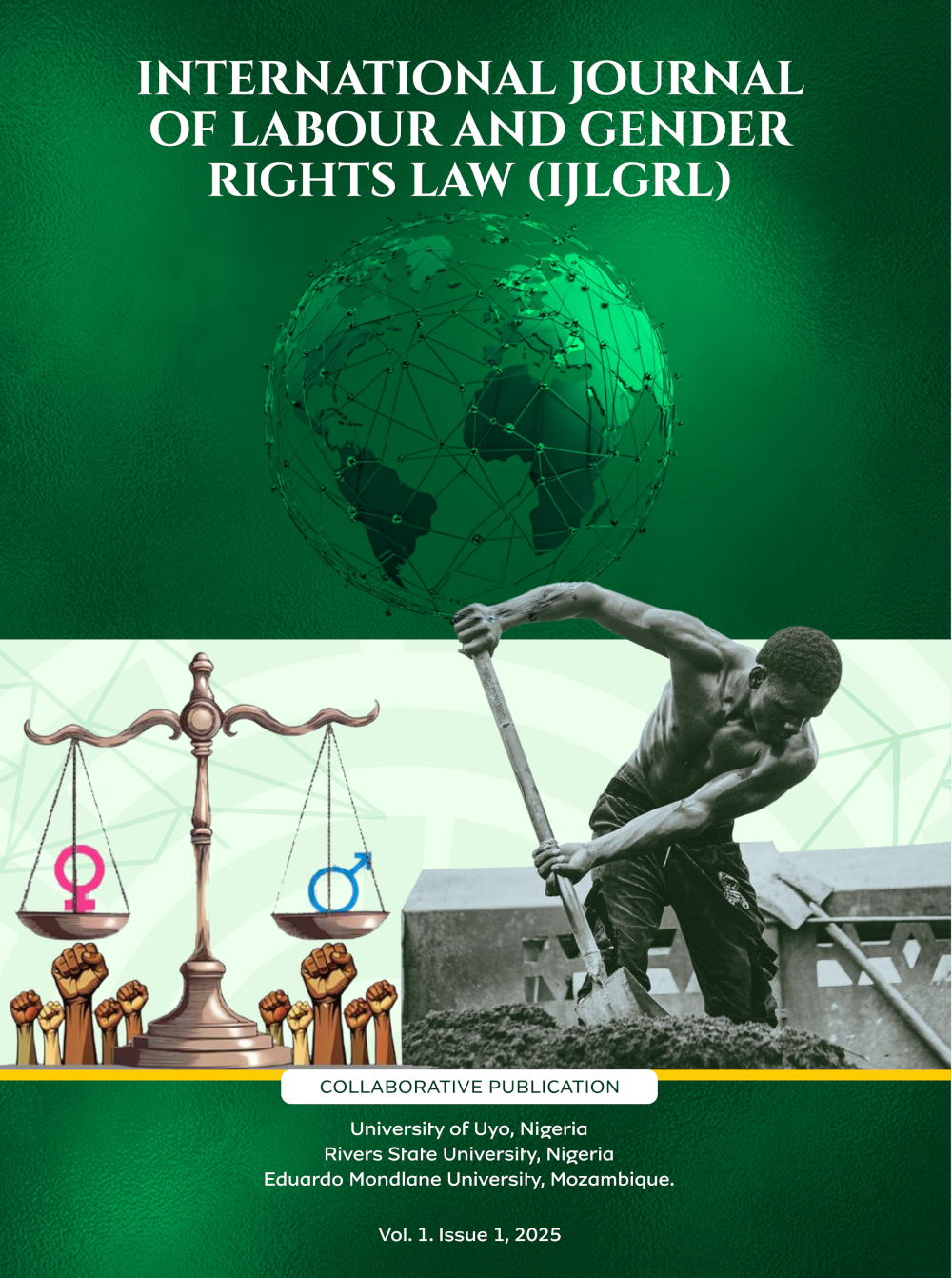
The collaborative foundation of the Journal, anchored by Rivers State University, Nigeria, the University of Uyo, Nigeria and Eduardo Mondlane University, Mozambique, underscores its commitment to cross-border academic synergy and intellectual exchange. This partnership enhances the Journal’s capacity to generate regionally grounded yet globally relevant scholarship, reflecting the shared and divergent experiences of African legal systems. It also provides a platform for emerging and established scholars to engage in interdisciplinary research that transcends geographical and institutional boundaries.
Furthermore, the Journal is designed to promote gender-sensitive legal scholarship by foregrounding issues that disproportionately affect women and gender minorities in the world of work. It encourages contributions that critically assess existing legal regimes, highlight gaps in protection, and propose reforms that align with international human rights standards. Through this focus, the Journal aspires to influence not only academic discourse but also advocacy and grassroots movements aimed at achieving substantive equality.
Ultimately, the International Journal of Labour and Gender Rights Law seeks to position itself as a leading voice in shaping conversations on labour and gender justice. By cultivating a vibrant intellectual community and maintaining high editorial standards, it endeavors to contribute meaningfully to the pursuit of fair, equitable, and dignified working conditions for all. Its long-term vision is to inspire progressive legal development and foster a more just and inclusive global labour order.